


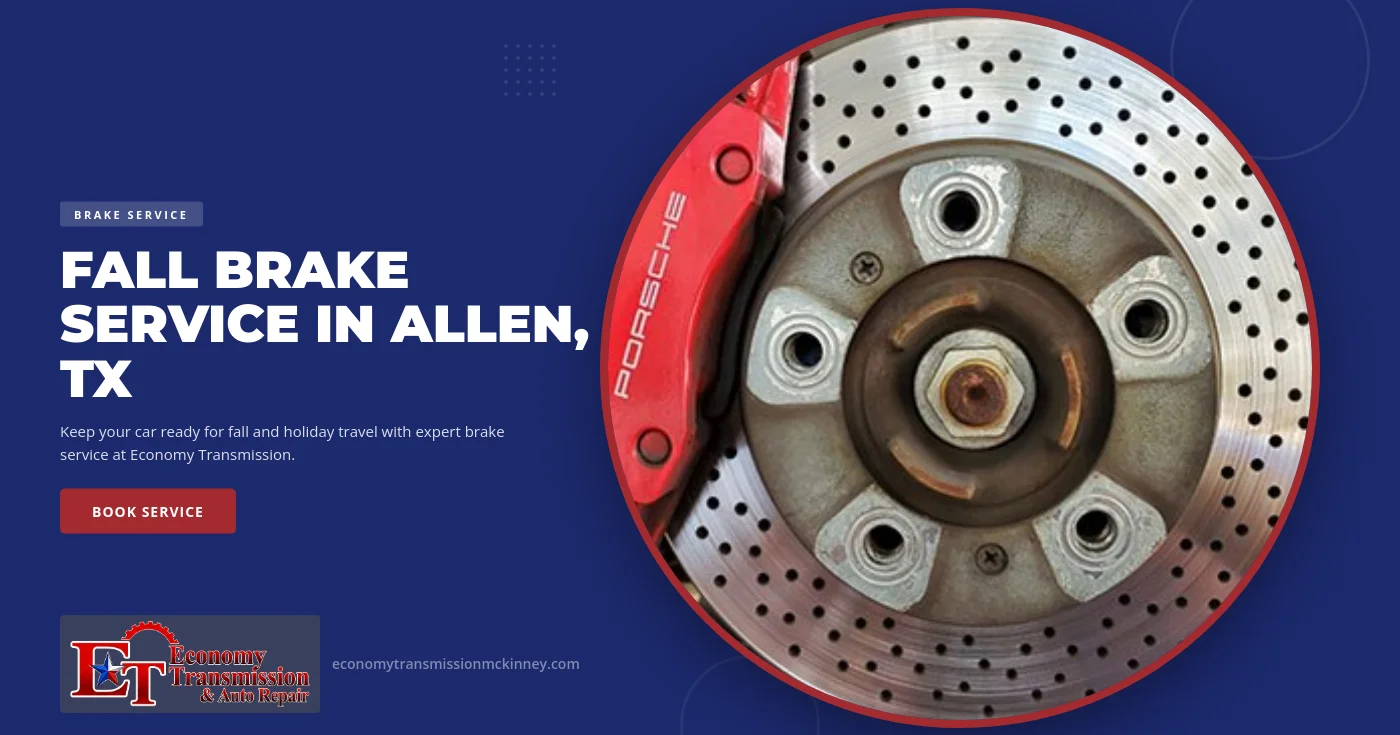
Fall has arrived in North Texas, and for drivers across Allen, TX, that means two things: a long summer of triple-digit heat is winding down, and the busiest driving season of the year — Thanksgiving, winter travel, and holiday shopping — is right around the corner. If your brakes have been quietly working overtime in stop-and-go traffic on Central Expressway, your car is giving you a short window to catch problems before they turn into expensive repairs.
At Economy Transmission & Auto Repair, we have served Allen, McKinney, Plano, and Frisco drivers since 1988. Our ASE-certified technicians have seen how Texas heat punishes a braking system, and we have built our fall brake service around catching the wear patterns that show up right now. Here is what every Allen, TX driver should know about brake service this season.
Why Fall Is the Right Time to Check Your Brakes in Allen, TX
Summer in North Texas is brutal on brakes. Ambient temperatures above 100 degrees combined with hot asphalt push pad and rotor temperatures well past their design range — and that is before you add stop-and-go traffic on Highway 75, towing a boat down to Lake Lavon, or hauling kids to practices across Collin County. By the time cooler fall weather arrives, your brake components have been through months of thermal stress.
Fall is the sweet spot for a brake inspection for three reasons. First, any damage from the summer heat — warped rotors, glazed pads, degraded brake fluid — is now easy to spot and still affordable to address. Second, the holiday travel season is weeks away, and holiday weekends are the worst time to discover a brake problem on an interstate. Third, cooler temperatures make for better test-drive conditions, so our technicians can isolate noises that were masked by air-conditioning fan noise in July. Federal crash data shows brakes are among the most-reported mechanical failure points in collision investigations — which is exactly why a 20-minute pre-holiday inspection is worth every minute.
Warning Signs Your Brakes Need Service Now
Most brake problems do not fail silently. Your car gives you weeks of warnings before you lose stopping power — the key is knowing what to listen for. Here are the signs we tell every Allen, TX driver to watch:
- High-pitched squeal when you apply the brakes. Modern pads have a metal wear indicator built in. When the friction material wears down to 2 to 3 millimeters, the indicator scrapes the rotor — a built-in warning that you have roughly 1,000 miles before you are into the metal.
- Grinding or scraping noise. If the squeal has been ignored, the pad is gone and the backing plate is grinding directly against your rotor. You are now replacing scored rotors too, and the repair bill doubles.
- Pulsing or vibration through the pedal. A pedal that bounces back at your foot almost always points to warped or unevenly worn rotors — heavy Texas heat is a leading cause.
- The car pulls to one side, or stopping distance has grown. One caliper may be sticking, a brake hose may be restricted, or pads may be wearing unevenly. If it suddenly takes an extra half-car-length to stop at the same intersection you drive through every morning, come in.
- Soft, spongy, or sinking pedal. Never ignore this one. Usually it means air or moisture in the brake lines, a leaking caliper, or a failing master cylinder.
- Dashboard brake warning light. Your car is telling you something has changed — low fluid, worn pads, or an ABS fault. Do not reset it and hope.
Any one of these on its own is a reason to book brake service in Allen, TX. Two or more, and we recommend you drive to our shop today rather than tomorrow.
What's Included in a Professional Brake Inspection
A proper brake inspection is more than a quick glance through the wheel spokes. When you bring your vehicle to Economy Transmission for Allen, TX brake repair, our ASE-certified technicians work through a full checklist:
- Remove each wheel and measure pad thickness front and rear with a caliper gauge.
- Measure rotor thickness and compare against the manufacturer's minimum spec.
- Inspect rotor surfaces for scoring, grooves, heat spotting, cracks, and warping.
- Check caliper movement, piston seal condition, and slide pin lubrication.
- Inspect brake lines and hoses for cracks, bulges, corrosion, or leaks.
- Test brake fluid for moisture content and visual contamination.
- Check parking brake adjustment and cable condition.
- Scan the ABS system for stored fault codes.
- Road test the vehicle to verify pedal feel, stopping distance, and any pulling.
When the inspection is complete, we walk you through what we found with photos so you can see exactly what your pads and rotors look like. If replacement is needed, we quote the repair up front with no surprise fees. If your brakes still have 20,000 miles left, we tell you that too.
Brake Pads vs. Rotors: Understanding the Difference
One of the most common questions we hear at our McKinney shop is "do I need pads, rotors, or both?" Here is the straight answer every Allen, TX driver deserves:
Brake pads are the friction material that squeezes against the rotor to slow your car. They are a consumable — they wear down every time you brake. Depending on your driving style, vehicle, and the pad compound, they typically last 25,000 to 70,000 miles. The hotter your typical driving (Texas summers, towing, heavy stop-and-go), the shorter that interval.
Brake rotors are the large metal discs that the pads clamp onto. They are not strictly consumable, but they do wear and warp over time. Most rotors can go through two sets of pads if they are cared for — but if pads are allowed to grind down to the backing plate, or if the rotor warps from overheating, you are replacing them earlier.
When we recommend pad replacement in Allen, Texas, we always inspect the rotor at the same time. If the rotor is above minimum thickness, has no deep scoring, and shows no warping, we can turn (resurface) it or leave it alone. If it is below spec or scored, we replace it — installing new pads on a damaged rotor ruins the new pads in a few thousand miles. We would rather tell you the truth now than see you back here in six months.
How Texas Heat Affects Brake Performance
Texas heat is not an abstract concern. It changes how your brakes behave, and the effects compound over a long North Texas summer. Here is what we see in our shop every fall:
- Brake fade. As pads and rotors get hot, their coefficient of friction drops. You push the pedal the same amount, but the car does not slow as quickly — most noticeable on long downhill drives or during repeated hard braking.
- Boiling brake fluid. Brake fluid absorbs moisture from the air over time, which lowers its boiling point. In Texas heat, old fluid can actually boil during hard braking — gas bubbles in the lines turn your pedal spongy at the worst possible moment. This is why we flush brake fluid every two to three years.
- Pad glazing. Repeated overheating hardens the surface of a brake pad into a glassy finish. Glazed pads make noise, grip poorly, and never fully recover.
- Warped rotors. Thermal expansion and uneven cooling can warp rotors over time — you feel the result as a pulsing pedal.
- Caliper seal damage. Rubber caliper seals are not designed to live at 400 degrees. Heat dries them out, and once they leak, you lose hydraulic pressure.
Fall maintenance in Allen, TX is really a chance to undo a season of thermal stress before the holidays arrive.
What to Expect During Your Brake Service Appointment
Brake repair is one of those jobs where a shop could easily tell you anything. We have built our process around removing that worry:
- Free written estimate. Drop your vehicle off, we complete the inspection, and we send you photos plus a line-item quote before any work starts.
- Transparent diagnostics. If we recommend a repair, we show you exactly why — the measurement, the photo, the manufacturer spec.
- Quality parts. As a NAPA AutoCare Center, we install NAPA brake components backed by a nationwide 24-month / 24,000-mile warranty — honored at any NAPA shop even if you move out of Texas.
- Same-day service when possible. Most standard pad and rotor jobs finish the same day — critical when the car is your only way to get the kids to school in Allen, TX.
- Road test and verification. Before we hand the keys back, a tech road-tests the vehicle to verify pedal feel, stopping distance, and no pulling or pulsing.
Most brake pad replacement in Allen, Texas takes 60 to 90 minutes per axle once parts are in hand. Larger jobs — new rotors, caliper rebuilds, fluid flushes — add time but still finish same day for most vehicles.
Why Allen, TX Drivers Choose Economy Transmission for Brakes
We have worked on cars in this community for 38 years. In that time, Allen, TX drivers have come to trust us because:
- We are a NAPA AutoCare Center with ASE-certified technicians, which means our work carries a nationwide warranty.
- We are BBB Accredited and have maintained that standing for decades.
- Our owner, Umit Muhammet, brings 15 years of hands-on experience and personally reviews every brake job that leaves the shop.
- We offer free estimates and a no-surprise-fees policy — the number you approve is the number you pay.
- Same-day service on most brake jobs — critical when your car is your family's lifeline.
When you choose brake service at Economy Transmission, you are not just getting pads and rotors — you are getting 38 years of local experience and a shop that still answers the phone when you call.
Frequently Asked Questions
How often should I get my brakes inspected in Allen, TX?
We recommend a brake inspection at every oil change — roughly every 5,000 to 7,500 miles. A dedicated full inspection should happen at least once a year, and fall is the ideal time because it catches damage from the summer heat before holiday travel. If you tow, drive in heavy stop-and-go, or notice any of the warning signs above, come in sooner.
How much does brake service cost in Allen, Texas?
Cost varies based on vehicle, pad grade, and whether rotors need replacement or resurfacing. A standard front-axle pad-and-rotor job on a typical sedan or crossover usually falls in a predictable range, and we quote every job up front with no surprise fees. We also offer free written estimates — bring your car in and we will give you a real number before any work starts.
Can I drive on worn brakes to get to your shop?
If your brakes squeal, pulse, or feel weak but still stop the car, drive directly to our shop with extra following distance. If the pedal sinks, grinds, or feels spongy, do not drive — call us and we will advise.
Do you offer same-day brake service?
Yes — most standard brake jobs are completed the same day. For complex repairs or vehicles that need parts ordered, we will tell you up front so you can plan accordingly.
What warranty comes with brake service?
Our NAPA AutoCare brake parts carry a 24-month / 24,000-mile nationwide warranty, honored at any NAPA AutoCare Center across the country. Peace of mind if you travel for the holidays.
Book Brake Service in Allen, TX Before the Holidays
The holidays are a terrible time to find out your brakes need work — and a great time to already have them handled. If your car has not had a proper brake inspection this year, now is the window. Our ASE-certified technicians in McKinney serve Allen, TX drivers every day and we would be glad to put your vehicle on the lift. Book your appointment today and roll into the holidays with confidence.