


The North Texas summer has finally broken, and family calendars in Plano, TX are pivoting into their busiest stretch of the year. Between school drop-offs, after-school activities across Plano, weekend sports up and down the Dallas North Tollway, and the first fall road trips of the season, most family vehicles will log more miles over the next four months than they did all summer. At Economy Transmission & Auto Repair, we see the same pattern every year: the cars that come in for a quick wheel alignment Plano TX drivers can rely on before fall driving picks up sail through the holidays without incident, and the ones that skip it often end up back in our bays in November with tire damage that started as a small pull in September.
A wheel alignment is one of the least expensive preventive services on the calendar, and it protects two of the most expensive systems on your vehicle — tires and suspension.
Why Fall Is the Ideal Time for Wheel Alignment in Plano
Fall is the ideal window for a wheel alignment for three reasons that stack on top of one another. First, the punishing heat of a North Texas summer is behind you, and everything on the suspension has just come through the season that stresses it hardest — rubber bushings, control arm mounts, tie-rod boots, and strut mounts all bake at 150°F or hotter under the vehicle every day for months, and the elasticity they lose shows up as small changes in geometry once the temperatures drop back down.
Second, the roads themselves take a beating from Texas weather. Asphalt in Plano expands and contracts through summer heat waves and the first cool snaps of autumn, and the potholes and rough patches that developed through the summer construction season are still fresh in October. If you have hit a pothole on Coit Road, a curb on Legacy Drive, or a rough stretch of US-75 anytime in the last three months, your alignment has almost certainly moved.
Third, fall and holiday driving stacks extra highway miles onto the vehicle exactly when tire condition matters most — school routes, longer commutes, and road trips to family in Austin, Houston, or Oklahoma. Book alignment before the mileage piles on and protect the tires you already have. Our schedule still has same-day availability in September; once cold fronts roll through, a walk-in becomes a four-day wait.
Signs Your Car Is Overdue for an Alignment
Most alignment problems announce themselves quietly. Drivers get used to a slight pull or a steering wheel that sits a few degrees off center, and the vehicle feels normal because the change happened gradually. The warning signs are consistent, though, and any one of them is a reason to book a check:
- The vehicle pulls to one side. On a straight, level stretch of Preston Road or Central Expressway, take a light grip on the wheel. If the vehicle drifts left or right without your input, alignment is the first thing to check.
- The steering wheel is off center. When you are driving straight, the wheel logo should sit level. If you have to hold it turned five or ten degrees to keep the vehicle straight, front toe angles are out of specification.
- Uneven or feathered tire wear. Run your hand across the tread, front to back. Wear that is heavier on the inside edge, the outside edge, or in a sawtooth pattern is caused by alignment — not driving style. Both outer edges usually points to underinflation; one edge points to camber or toe.
- Squealing on turns at low speed. Tires that scrub instead of roll make noise on tight corners. If your minivan or SUV started chirping on the turn into your driveway, alignment is a strong candidate.
- Steering wheel vibration. A shimmy at highway speed is often traced to wheel balance, but a vibration that pulses through the steering column at any speed can involve alignment or worn suspension components.
- Tires wearing out faster than they should. A set rated for 60,000 miles showing wear at 35,000 or 40,000 has almost certainly been misaligned somewhere along the way. According to AAA guidance on wheel alignment, improper alignment causes tires to wear unevenly, shortening tire life and reducing fuel efficiency.
- You just hit a pothole, curb, or road debris hard. A pothole on the George Bush Turnpike or a curb strike backing out of a spot at Legacy West is enough to knock a vehicle out of specification, even if the wheel and tire look untouched.
The general recommendation from AAA is to have alignment checked roughly every 12,000 miles, or whenever tires are serviced. Plano drivers who commute daily on the Tollway or US-75 benefit from a check at least once a year and any time one of the symptoms above appears.
How Texas Summer Heat and Road Conditions Knock Vehicles Out of Alignment
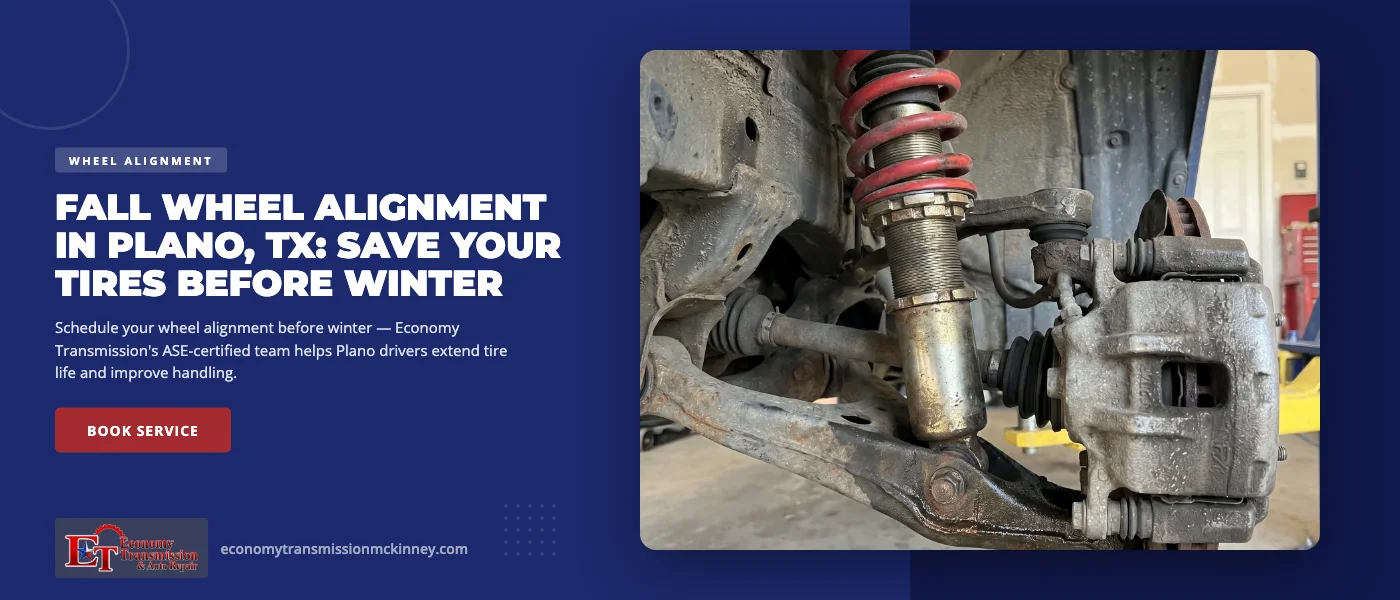
Alignment is a set of three geometric angles — camber, caster, and toe — that describe how each tire sits relative to the road and to the vehicle's centerline. Manufacturers specify these angles to within tenths of a degree, and anything that moves the suspension mount points, steering knuckles, or tie rods by even a small amount can push those angles out of specification.
North Texas summers accelerate the changes in three specific ways. Prolonged surface temperatures of 140°F or higher under the vehicle degrade rubber bushings in control arms and sway bars — the components that hold the suspension geometry in place. Once bushings lose flexibility, the wheels shift under load in ways they did not shift when the parts were fresh, and edge wear on the tires shows up within a few thousand miles.
The road surface itself is the second factor. Every hard impact — every pothole hit at 40 mph on Independence Parkway, every driveway curb caught at an odd angle, every rough railroad crossing through downtown Plano — sends a shock through the suspension that can bend a tie rod, deform a control arm, or shift a strut mount. Combined with late-summer heavy loads (soccer gear, four kids, a bike rack on the hitch), the geometry drifts. That is why so many of the alignment jobs we perform in October and November come from vehicles that were perfectly aligned in April.
What Happens During a Professional Wheel Alignment Service
A modern alignment is a precise digital measurement, not the old-school string-and-eyeball job it was decades ago. When you drop off with us, the process follows the same disciplined sequence every time.
We start with a road test. Even a two-mile drive tells our ASE-certified technicians whether the vehicle pulls, wanders, or feels crisp on the steering. Back at the shop, the vehicle goes on our alignment rack. Digital sensors clip to each wheel and read camber, caster, and toe at all four corners to within one-hundredth of a degree. That reading is compared to the manufacturer's specification for your specific vehicle — trim, wheel size, and year all matter — and any angles outside the green range are flagged.
Before adjustments begin, we inspect the suspension. If a tie rod is worn or a ball joint has play, we stop, contact you, and walk you through what we found. Adjusting alignment on top of failed suspension components wastes the alignment — the geometry will not hold. Our free-estimate policy means you owe nothing to hear the recommendation, and no work moves forward without your approval.
Once the suspension is verified, the technician adjusts each angle back to specification. Toe is set at the tie rods; camber and caster, on vehicles that allow adjustment, are set at the strut mounts or camber bolts. Many modern vehicles have independently adjustable rear wheels that get set at the same time. When every reading is inside specification, the technician takes the vehicle back out for a final road test.
You leave with a printout showing the before and after readings for every angle, so you can see exactly what changed. For most vehicles the entire process takes 60 to 90 minutes, and same-day service is standard. Our wheel alignment service page walks through the equipment and process in more detail.
How Proper Alignment Saves Money on Tires and Fuel
Wheel alignment is one of the few maintenance services that pays for itself measurably. The savings show up in three places.
The biggest return is tire life. A misaligned vehicle wears tires in patterns that shorten their useful mileage significantly — industry research summarized in general reporting attributes roughly a 20 percent reduction in tire life to persistent misalignment. On a set of four tires priced at $250 each — a typical figure for a Plano SUV — that is $200 lost across a single tire cycle, and much more if the wear is severe enough to force early replacement. A single alignment now often pays for itself in tire life alone.
The second return is fuel economy. Tires that scrub instead of roll create rolling resistance, and the engine works harder to overcome it. The federal FuelEconomy.gov maintenance guide notes that keeping tires properly inflated improves gas mileage by up to three percent, and correct alignment amplifies that effect by keeping the contact patch flat against the road. For a Plano commuter driving 15,000 miles a year at 25 mpg, a two-to-three-percent gain adds up to real dollars.
The third return is the one drivers notice first — how the vehicle drives. A correctly aligned car tracks straight without input, the steering wheel is centered, cornering feels stable, and the ride is quieter because the tires are no longer fighting the pavement. Peace of mind for the driver, less fatigue on long trips, and a vehicle that holds its value better at trade-in time.
Add in the reduced strain on suspension components — tie rods, ball joints, wheel bearings, and control arm bushings all live longer when alignment is inside specification — and the wheel alignment Plano TX drivers book each fall is one of the highest-return maintenance decisions on the calendar. Pair it with regular preventive auto maintenance service and the compounding savings keep growing over the life of the vehicle.
Why Plano Drivers Choose Economy Transmission for Alignment Service
Economy Transmission & Auto Repair has served Plano, McKinney, Frisco, Allen, and surrounding communities since 1988 — 38 years of continuous operation under the same family-oriented, straight-recommendation approach. Owner Umit Muhammet brings 15 years of hands-on experience to every diagnosis, and our team of ASE-certified technicians handles alignment as one of the routine services we perform every day.
A few specific reasons Plano drivers make the drive to our shop for alignment work:
- ASE-certified technicians. Every technician has passed the national ASE examinations and re-certifies every five years. Alignment is a precision service and the skill of the technician on the machine matters as much as the machine itself.
- NAPA AutoCare Center. Our work is backed by NAPA's 24-month, 24,000-mile nationwide Peace of Mind warranty — any NAPA AutoCare shop in the country can honor it on a road trip.
- Free estimates and no-surprise-fees policy. The price we quote is the price on the invoice. If additional wear is discovered during the alignment, we stop, call you, and get approval before continuing.
- Same-day service on most alignments. Drop off in the morning, get a call before lunch with your alignment results, and pick up in the afternoon. Our shuttle and after-hours key drop-off make the timing work with a family schedule.
- Printed before-and-after alignment reports. You see the readings for every angle. Nothing about our recommendations is guesswork.
Whether the tire wear looks off, the steering wheel is drifting, or you just want a preventive check before the family car takes on the fall season, the wheel alignment Plano TX drivers count on is a same-week appointment. We would rather catch alignment issues early than watch them turn into a much larger tire replacement two months from now.